Regulators and payers have raised major concerns over recent spikes in drug prices. Unjustified high drug prices (see Valeant case) have triggered not only political comments from U.S. presidential candidates in the previous U.S. elections (see Hillary Clinton’s statement) but also a broader discussion on how drug prices can be regulated and whether the European drug pricing model (reference pricing) should be adopted.
In this article, I will discuss the differences between U.S. and E.U. drug prices based on the case of CNS drugs. Prices have been drawn from various sources including reported Wholesale Acquisition (WAC) prices as well as from a number of journal articles.
The following indications will be analysed: Multiple Sclerosis, Neuropathic Pain and Parkinson’s Disease. These disorders account for ~50% of the global CNS market (excl. psychiatric disorders such as depression, schizophrenia anxiety or eating disorders).
Multiple Sclerosis (MS)
Disease Description: MS is a neurodegenerative disorder in which the insulating covers of the nerve cells in the brain and spinal cord are damaged causing a range of symptoms (mental, muscle, ophthalmic).
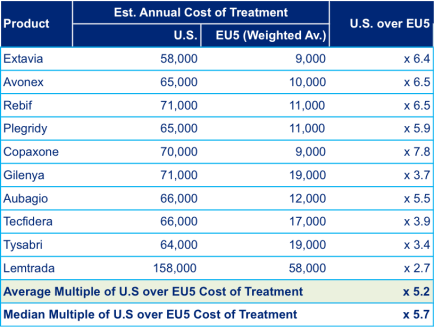
MS market: is highly crowded by various drugs that are prescribed based on disease progression. First line therapies include beta interferons (Avonex, Rebif, Extavia and Betaseron) which are injectables, Copaxone which is also an injectable and finally Aubagio, Tecfidera and Gilenya (Gilenya has been approved as first-line therapy in the U.S. but as second-line therapy in the E.U.) which are oral therapies. First-line therapies account for approx. 80% of the USD 22 bn. MS market.
Neuropathic Pain
Disease Description: Neuropathic pain is a chronic pain disorder in which nerve fibers have been damaged sending the wrong signals to the somatosensory system. There are 3 types of neuropathic pain: painful diabetic neuropathy, postherpetic neuralgia and trigeminal neuralgia.
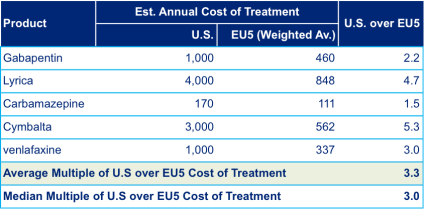
Neuropathic Pain Market: Painful diabetic neuropathy accounts for 90% of the overall neuropathic pain market which is estimated at USD 2.5 bn.
Parkinson’s Disease
Disease Description: PD is neurological disorder that affects the region of the brain responsible for movement. PD slowly progresses from Stage I (mild symptoms) to Stage V (aggressive symptoms), which are generally broken down to two major patient categories: early stage patients and advanced stage patients.
Parkinson’s Disease Market: The global PD market is estimated at USD 3.5 bn. with the advanced stage segment holding a share of ~70%.
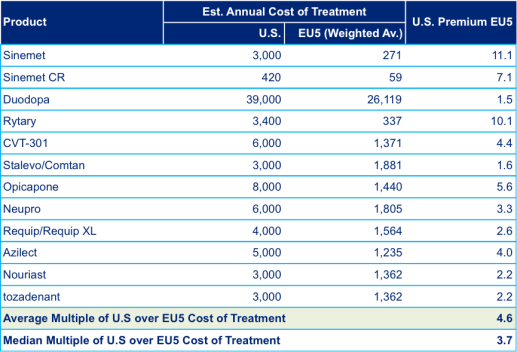
Across all 3 CNS indications, U.S. pharmaceutical prices are approximately x 4.4 greater than EU5 prices. This is one of the main reasons that most pharmaceutical and biotech companies target FDA approval first; A company can argue to European authorities that this is the drug price approved in the U.S. and thus it should be considered as a basis for receiving a high price in European countries as well.
Are such high prices in the U.S. justified? It depends on what the U.S. market economy is trying to achieve. High drug prices is one of the incentives for U.S. biotech companies to continue innovate and for VCs to continue invest in U.S. biotech companies. In fact, the amount of VC funding that U.S. biotech firms receive is triple compared to what European biotech companies receive.
Therefore, the question is shaped as follows: how can U.S. drug prices be regulated without causing a VC funding crisis but also without resulting in a disruption of the biotech stock market?
 DSD
DSD 